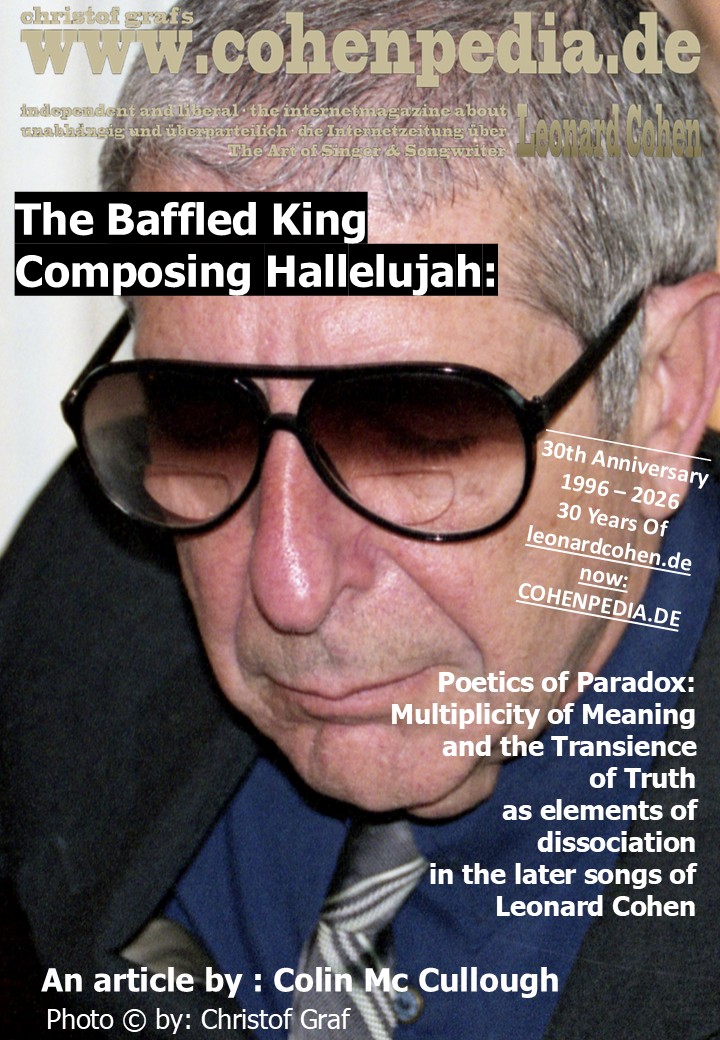
The Baffled King Composing Hallelujah: Poetics of Paradox: Multiplicity of Meaning and the Transience of Truth as elements of dissociation in the later songs of Leonard Cohen
Many thanks for sending me this article; published by permission of Colin Mc Cullough
Photo © by: Christof Graf
Introduction
Cohen’s later songs diverge from his earlier work – pre-2000 – in that they are more concerned with the major questions that face the individual such as death, mortality, love, the passage of time and pain rather than his earlier focus on his relationships. Unlike his earlier songs there is a lack of social and political commentary. This change in focus may have earned Cohen the name of “The Godfather of Gloom” or the “Pet Laureate of Despair” in contrast to such earlier titles such as “The Bard of the Boudoir”. This deficit has been the subject of criticism of the inverted nature of Cohen’s expression.
The popularity of Cohen has basically shaped how he was received as a visionary but reduced critical analysis of of his work. The depiction of Cohen as a lonely man of vision with insight has reduced the criticism of his work and largely ignored the more complex character of his songs. He is regarded as introverted and constructing a personality where social and political commentary does not exist. Commentary in fact increased his standing as someone prophetic although this has been challenged by several critics. Kvennefelt (2001) and Watson (2008), place in question the perspective of Cohen as a visionary poet for instance, they question the idea of a male poet where his role as a visionary or prophet forcefully isolates him and reacts against regarding him as social or political commentator. Guindon’s Bourdieu-inspired analysis takes this critique further, arguing that Cohen’s consecration as a prophetic artist is sustained as much by the institutional and cultural structures that shape literary reputation as by any private or transcendent insight.
Even mainstream commentary acknowledges this inwardness, though often unintentionally. Hadassah Magazine (2015) describes Cohen’s songs as “intensely personal and introspective” – positive criticism which is laudatory but which again sees the artist removed from social reality regarding him as a persona who merits praise. Karmakar (2016) approaches Let Us Compare Mythologies from an existential perspective, drawing attention to the limits of this inward focus. For Karmakar, much of Cohen’s early poetry and songwriting revolves around personal turmoil and private imagery that remain enclosed within the self, rarely breaking into communal or political space. The prophetic claim, then, is undercut by the very intensity of his introspection. More recently, F. Mus (2021) has mapped Cohen’s position between literature and music, noting that the persistence of a “singular self” across his work restricts its dialogic reach. Cohen’s art, Mus suggests, often turns toward the self as both subject and horizon, constructing a voice of authority that leaves little room for otherness or collective experience.
Ignoring the social and political perspective and focusing on his profoundness as a visionary blind him as an artist who is not a persona. The image as poet and visionary rather than stressing the complex character of Cohen’s work simply flattens it, by changing the spirituality of Cohen’s work into the vision of solitary wisdom. As such Cohen’s introverted insight is both its strength and its confines as it makes his social horizon much narrower limiting it to an examination of the self albeit in a beautiful way.
This tension forms the core of the later work of Cohen, the relationship between the self and the world between self and world, and his search within dissociation and the transience of truth. The shift towards introversion is what defines him as a visionary or prophet and leads to his grappling with fragmentation, contradiction and uncertainty. As the prophetic voice falters, Cohen turns increasingly toward the fractured nature of perception and the instability of meaning itself. The following discussion will trace how the themes of dissociation and the multiplicity of truth emerge from this inward gaze – not as signs of prophetic authority, but as expressions of an artist confronting the limits of self-knowledge and the impermanence of all revelation. The introverted nature of Cohen’s later lyrics therefore, were not free from criticism.
His later work is defined by three interwoven phenomena: dissociation, the multiplicity of meaning and the transience of truth. By ‘late works,’ I refer to Cohen’s songs composed after his forced return to touring in 2008. However, I also include earlier songs – such as Anthem, Hallelujah, Closing Time, and If It Be Your Will – since their recurrence in his later concerts underscores their enduring significance and relevance of his later “message”.
The themes of dissociation, multiplicity of meaning and the transience of truth can be traced back through his lyrics, his written poetry and notes verbally shared in his last years. This essay will initial define the concept of literary dissociation and will examine the use of dissociation in his songwriting; it will then proceed by briefly portraying Cohen’s literary heritage and then continue by addressing the transience of truth and Cohen’s multiplicity of meaning both of which are inseparable from the use of literary dissociation.
Cohen separates voice from self, sacred from secular, and body from spirit, crafting a poetics built on fracture where frailty itself becomes creative strength
Edward Said, a prominent literary critic and theorist argues in “Late Style . Music and Literature Against the Grain” after studying the later works of many artists including Charles Dickens, Virginia Wolff and T. S. Eliot comes to the conclusion that in general the later works of artists show estrangement, detachment and a deep engagement with the problems of life. As Edward Said argues in On Late Style, late works often embrace fracture, paradox, and irresolution, refusing the harmony of earlier creations. There were, however, in the context of Cohen, very differing views of aging and late style. As Gordon McMullan a literary school has argued a notion of late style reinforces inherited ideas about exceptional genius. He states, ”Late style, by contrast, holds out the possibility of a final flowering, a resurgence of creative power at a stage at which it might be expected to be slipping away …” In this he concurs with the reasoning of Adorno who suggests that late style often embodies a critical distance from established norms and conventions, reflecting the artist’s struggle with their own legacy and the societal context in which they create.
Dissociation has a history in literary tradition. T. S. Eliot, for example, urged artists to keep a distance between thought and emotion. He believed that poetry should refine feeling through intellect, that experience must pass through the discipline of form. That split – between the reasoning mind and the restless heart – became one of modernity’s deep habits. A century later, Leonard Cohen seems to move in the opposite direction. His later songs bring thought and feeling back into conversation, as if intellect itself had grown tired of its own detachment. Francis Mus, author of “The Demons of Leonard Cohen” treats Cohen’s fragmentation and multiplicity not as flaws but as essential to his artistic identity. Where Eliot’s poet struggled to master emotion, Cohen’s accepts it as a teacher. His work doesn’t erase the division that modernism enshrined, but it treats it tenderly, turning separation into a kind of harmony – the mind bowed, at last, before the heart. Cohen’s later songs show this clearly – divided voices and lingering tensions turn fragmentation itself into a kind of power.
“In You Want It Darker and the the albums which preceded this are those in which Cohen writes at a certain distance: it is he voice of an exile. What once felt like alienation becomes, in these songs, a place of conversation with the divine. When he sings “Hineni, Hineni – I’m ready, my Lord,” or longs for a “treaty between your love and mine,” he isn’t asking to be spared from pain. He is asking that the pain be made meaningful. The separation doesn’t end, but its purpose changes: it becomes the quiet space in which humility can breathe. In these later works, the long silence between human longing and whatever might answer it begins to sound like prayer.
In Show Me the Place, Cohen kneels inside that silence. The song is a weary prayer, a voice asking not for escape but for guidance. “Show me the place where the word became a man,” he pleads, turning scripture into a kind of confession. Suffering, here, is not an obstacle but a landscape to move through carefully, reverently. In Come Healing, he gathers what is broken and offers it up – “O gather up the brokenness and bring it to me now.” The wound becomes the altar. Even in Treaty, where love and reconciliation seem just out of reach, the longing itself feels holy. He has stopped trying to seal the distance; instead, he listens to it, lets it teach him. These songs don’t ask for deliverance from pain – they ask for the grace to recognize pain as a kind of visitation.
The concept of dissociation was further developed by Jacques Derrida in the 1960’s and the Yale School of Deconstruction in the 80’s where text was regarded as something whose meaning was unstable and in which interpretation always revealed contradictions and ambiguity. Literature, therefore, could never offer a single meaning or ultimately be knowable. Again looking at Cohen’s lyrics it is clear how his techniques mirrored such a philosophy. In Anthem for example the words “Ring the bells that still can ring / Forget your perfect offering / There is a crack, a crack in everything / That’s how the light gets in.” there is no reference to what the crack could be, this is left to the audience’s interpretation. There is no correct interpretation; the lyric both mourns imperfection and celebrates it. This paradox is never resolved or is there any attempt to do so.
Cohen’s music as he aged changed from brokenness to a position of acceptance of what cannot be answered by intellect. The man who once sang to escape the wound now sings from within it, as if the ache were the last true home. What began as dissociation ripens into devotion; what was once fracture becomes faith. In his final songs, the silence between the self and God – once unbearable – is no longer empty at all. It has become the song itself.
“O gather up the brokenness / And bring it to me now.” from “Come healing “ is the call of the divine power, God or higher self to be happy with the imperfection we bring to it. The brokenness is not to be repaired but accepted. Cohen sees brokenness itself as the place where grace can enter. In „Show me the place“ the lyrics “Show me the place where the word became a man. Show me the place where the suffering began.” Here the voice is weary and he himself is stripped of identity. He accepts his helplessness before the divine power.
TIn “Going Home” Cohen sings:
I’d love to speak with Leonard
He’s a sportsman and a shepherd
He’s a lazy bastard living in a suit
But he does say what I tell him
Even though it isn’t welcome
He just doesn’t have the freedom to refuse
He will speak these words of wisdom
Like a sage, a man of vision
Though he knows he’s really nothing
But the brief elaboration of a tune
This split works as a deliberate challenge to fixed notions of artistic control or authorship. By separating Leonard (the ego-driven individual) from the higher voice (the true source), Cohen argues against Romantic notions of the inspired individual genius. The dissociation privileges the higher voice/authentic inspiration over Leonard/personal ego, arguing that authentic art comes not from personal will but from surrendering that will. The dissociation creates the philosophical pair go-driven creation/transcendent creation. “He wants to write a love song” represents false or incomplete artistry, while the higher voice’s commands represent authentic artistic expression. Transcendent creation serves as the criterion for evaluating ego-driven creation, revealing the latter as equally important is the fracturing of identity: the voices in these songs waver over who they are, what they recall, and how they fit into the world.
Dissociation as we have seen may also surface through the motif of the double or the split self as we saw in “Going Home”. Here the speaker presents multiple selves or competing forces within one framework – voices of faith and doubt, love and separation, hope and despair. These conflicting identities testify to a consciousness divided within itself. Songs such as Treaty and Leaving the Table exemplify this, where multiple, fragmented voices emerge in spiritual dissonance. In these works, Cohen stages dialogues between shadowed aspects of the self, dramatizing contradictions without closure. The name of the song itself indicates a state of detachment. the question is for the audience detachment from what. This question is not answered in the song. It is left to the listener to decide; detachment from relationships, earthly matters or even life itself. This technique is typical of Cohen, leaving such questions unresolved, free for the interpretation of the listener.
The transience of truth and the multiplicity of meaning are essential elements of dissociation. The three elements are inextricably entangled. The changing nature of truth and the layering of meaning are elements which compose the dissociation, neither can be viewed in isolation from dissociation, they are integral parts of it. Both the transience of truth and the multiplicity of meaning are elements of which dissociation is composed.
Multiplicity of Meaning
A central consequence of dissociation in Cohen’s late work is the constant multiplication of meaning. His songs resist single interpretation, instead holding contradictory possibilities in suspension. Cohen’s lyrics generate meaning that is complex, tentative, and influenced by each listener’s personal emotional and spiritual framework. He deliberately keeps central images – the wound, the altar, the lover, God himself – open to multiple readings, inviting audiences to take an active role in constructing significance from what he leaves unresolved. Rather than guiding listeners toward one authoritative reading, Cohen constructs lyrics that accommodate multiple interpretations, with none elevated above the rest. This interpretive flexibility is not a flaw but a deliberate strategy: the song becomes a space where ambiguity is maintained and celebrated rather than dispelled. For Cohen, dissociation often involved the creation of a protagonist. This narrator has the ability to witness, engage, or even speak to the author him/herself as if this author were another character outside the scope of his/her narration. This distancing consists of the division of what would otherwise be a single self, or point-of view into various warring selves or voices. The voice thus becomes fragmented, elements of personality become estranged and identity fragmented.
One of the more overt examples of this is in “Going Home” where Cohen describes himself as “a lazy bastard living in a suit”. The lyrics continue “He will speak these words of wisdom…though he knows he’s really nothing but the brief elaboration of a tune.” which portrays the identity as divided: The dissociation operates on the traditionally unified concept of the artist; – a single term that encompasses both the creative individual (Leonard the man) and the source of artistic inspiration. In Romantic and post-Romantic discourse, the artist is typically conceived as a unified creative agent who both experiences and expresses artistic vision. The split between personal identity and a higher power that is the origin of his art. In another sense the fragility or transience of truth and the multiplicity of meaning and the use of dissociative techniques in Cohen’s songs may offer some insights for creative writing instruction and literary composition. Cohen’s dissociative approaches also can serve as a valuable case study for anyone teaching or studying how literature can achieve complex effects through deliberate stylistic and multiplicity of perspective. Drawing on Cohen as an example, writers can cultivate specific methods for disrupting their habitual narrative structures – for instance, by deliberately fracturing or multiplying the „I“ within their work to explore contradiction, irony, or layered meanings. Cohen’s late-career recordings reveal a profound engagement with dissociation, manifest not only in his language but in the architecture and quality of the sound itself. The contrast between Cohen’s worn, bass-register voice and the radiant, nearly otherworldly vocal harmonies surrounding it creates a sharp bifurcation: mortality placed against transcendence, incompleteness against unity.This dynamic produces a perceptible gap – a space between the self and its sonic environment – that becomes fundamental to the emotional and conceptual terrain his music inhabits.Laura Barton in “Looking at Leonard Cohen’s darkness misses the warmth of his words,” says “ Cohen’s work to me is about light and shade, the perpetual shifting of perspective from inner to outer and back again.” It is this shifting of perspective which is he essence of dissociation in Cohen’s work.
The spare instrumentation and deliberate pacing of Cohen’s later work seem to establish a contemplative space where meaning hovers unresolved rather than reaching conclusion. Through deliberate use of silence, repeating patterns, and the movement between spoken word and song, Cohen establishes circumstances in which identity grows fluid and individual consciousness withdraws. The spaces between sounds carry as much expressive weight as the sounds themselves, articulating the rupture central to his perspective – a reality simultaneously fractured and radiant in its fragmentation. This aesthetic of withholding reaches its peak in You Want It Darker, his fourteenth studio album, where what is missing itself acquires a kind of presence. As Kitty Empire observes, “The bleak and sparse arrangements… make his repeated leave-taking all the more exquisite.” The music’s minimalism amplifies its emotional intensity: every pause, every silence, becomes a meditation on departure. In this way, Cohen’s art transforms brokenness into a philosophical stance – an acceptance that beauty may persist, even flourish, within the experience of dissolution.
Any account of Cohen’s later artistic paradoxes must first acknowledge the literary foundations upon which his voice as a songwriter was built.
Cohen’s Literary Foundations
Before embarking on his music career, Cohen had already gained standing as a notable presence in Canadian literary communities. His second novel, Beautiful Losers, though a commercial failure, provoked critical debate for its formally unconventional structure and explicit sexual depictions. In later statements, Cohen indicated that he turned to songwriting because it appeared to provide more sustainable prospects than persisting solely with poetry and prose. By that point, however, he had published six books, including The Spice-Box of Earth and Beautiful Losers, works that established his literary presence. His Selected Poems, which won the Governor General’s Award (an honour he famously declined), further cemented his stature in Canadian letters.
In a review of Beautiful Losers in Marshall Delaney, of the Toronto Daily Star, wrote that it was “the most revolting book ever written in Canada,” and called it “verbal masturbation”. Prior to launching a profession in music, Cohen was well known on the Canadian literary scene during the 60’s. Cohen was also recognized early within Montreal’s Jewish community, where the Canadian Jewish press frequently highlighted his work as part of a new generation of Jewish-Canadian poets. Shoshana Dayan’s thesis, Poets and the Canadian Jewish Community: Three Portraits, chronicles this reception and positions Cohen within a wider cultural landscape, though mainstream critics did not consistently view him as belonging to any particular generational cohort. Irving Layton, his mentor and an acclaimed Jewish-Canadian poet, bolstered Cohen’s reputation through vocal public support.Cohen himself recalled a striking instance of this visibility when the Canadian Jewish Chronicle ran the headline ‘POET-NOVELIST ACCUSES JUDAISM OF BETRAYAL’ after one of his community talks, marking his notoriety as both a literary and cultural provocateur.”
Literary dissociation and existential dimensions These formative literary years, characterized by both scandal and critical acknowledgment, not only informed Cohen’s artistic sensibility but also anticipated the motifs of rupture, multiplicity, and dissociation that would emerge again in his subsequent musical work.
Case studies
In “Treaty” (You want it Darker, 2016 ), the power dynamic becomes more openly religious. Cohen at the beginning of the songs sings “I’ve seen you change the water into wine” – a literal mention of Jesus’ first miracle. But the next plea – “I wish there was a treaty between your love and mine” – makes explicit what remains implicit in the song’s title: the unbridgeable gap that opens up, once we have crossed its threshold as lovers, between divine and eternal love, on the one hand, and human love on the other. Once again, Cohen sets the rupture between the hallowed and mundane in motion, embodying the lingering tension between our godly and worldly states. Treaty is about reconciliation and can be interpreted as reconciliation in human relationships or between human and the divine.
The song “Treaty” (You Want It Darker” 2016) reflects that state of human openness as it expresses a deep desire for peace – between man and the divine, or between two people. The chorus “I wish there was a treaty between your love and mine” expresses a yearning: for real union and reconciliation, even though that may be impossible. Cohen muses on the illusions that love generates. The beloved is turned into a ghost – an illusion defined by how the lover imagines and expects, and the fiction which exists only in imagination. This is a deep emotional dissociation: at this point, one no longer fully perceives the other person as an autonomous human being but instead sees only a projection formed by desire. And yet, even within this illusion, the relationship may still provide genuine forms of stability and connection “you are my areal” expresses the way love lifts up the soul, providing a kind of connection to something bigger. They are also lines full of dependence; when finally the acceptance of static arrives, there’s a sense not only that a connection has been lost, but now the speaker is less involved. Love idealizes and holds up: it is, in part, a delicate illusion, but even so sustains and uplifts the one who loves. Bartering oneself for love can forge deep bonds, but as the song.
The reconciliation and can be interpreted as reconciliation in human relationships or between human and the divine. The voice conveys weariness while articulating a profound desire for rest. The phrase „I’ve seen you change the water into wine“ explicitly invokes a miracle performed by Jesus. But he continues „I’ve seen you change it back to water to“ which infers that the sacred has also been guilty and mundane. As such it is a doubting voice in relation to the teachings of the bible. „I sit at your table every night“ raises the question of his feeling of an answer be it from the divine, the lover in a relationship or mankind in general.
What does Cohen mean when he says „I do not care who takes this bloody hill“. Again it is an exhausted voice singing in a whisper without strength who admits he is indifferent to a battle. He does not care who is the victor. All the while the music is slow and simple allowing the listener to focus on the words. The song then repeats his wish for a treaty, the end to conflict – this is a line repeated throughout the song. „We’re dancing in the streets this jubilee, we sold ourselves for love but now we’re free“ sees the release from love as jubilation and liberation being freed from love Yet it was a love which had its price which had to be paid, be it in terms of self denial. He continues „I’m sorry for that ghost i made you be, only one of us was real and that was me“ which seems to state that one person in a loving relationship turns the other into something which is a figment of his own imagination. Yet this feels real or authentic in the experience of the lover.
The song continues with the feelings of the singer for from love had meant much, „You’re my ground, my safe and sound, you were my aerial“. The partner in love had become his way of communicating with he world, or making some sense of it. „I heard the snake is baffled by his sin, he shed his scales to find the snake within“ again has a biblical context, the snake symbolizing temptation as in the book of Genesis. The baffled by its skin can signify that even evil no longer understands itself. T soul is trapped in its own nature. „But born again is born without a skin, the poison enters in to everything“. In this Cohen is expressing about all of humanity, we are all trapped within ourselves. The snake or sin in that we try to purify ourselves of it, it can only uncover its own nature, nothing else is possible.
I find it notable that Cohen takes up the song again in the final track on the album. It is largely only music but ends with the tired voice of Cohen saying „I wish there was a Treaty we could sign, its over now the water and the wine” Cohen knew he was terminally ill and would soon die. These were his final words and final message to his listeners. – the contradictions he found in life remain unresolved butt he accepts these peacefully.
The work reflects Cohen’s reaction to aging, loss and spiritual search. “You Want It Darker”, Cohen’s last album, is a statement on the end of life. Writing in The Guardian on November , Stephanie Convery said it was „a valedictory hymn from a man who had come to terms with his death“. It’s an album that feels like a goodbye: somber, earnest. He speaks not as an author in control, but as someone in service to the song itself.
Going Home
Going Home is a song about death and mortality. It feels like a quiet conversation between Leonard and something greater than himself. It’s a song about surrender – not in defeat, but in recognition. It carries the weight of an artist’s struggle, the strange mix of burden and freedom that comes with creating, and a sense that he’s slowly preparing to let go of this life. More than anything, it shows that split inside Cohen – between the man who walks through the world and the voice that sings through him. Billingham fällt dabei besonders das im Song erwähnte ‚Kostüm‘ auf und stellt diesbezüglich fest: „The absence of ‘costume’ also carries with it an innate condition of nakedness and vulnerability more existential than materialist.“
The song opens with:
“I’d love to speak to Leonard,
He’s a sportsman and a shepherd,
He’s a lazy bastard living in a suit.”
Right away, there’s distance. Someone – maybe God, maybe the muse – is talking to him. The voice feels both loving and irritated, like it knows him too well. Calling him a “lazy bastard” feels playful but also cutting. The idea of him being “clothed” – “living in a suit” – makes it sound like he’s hidden behind his role, that there’s something truer underneath that he can’t quite show. Billingham fällt dabei besonders das im Song erwähnte ‚Kostüm‘ auf und stellt diesbezüglich fest: „The absence of ‘costume’ also carries with it an innate condition of nakedness and vulnerability more existential than materialist.“
Even so, Cohen doesn’t take himself too seriously.He allows humour to temper the severity of self-reproach..
He writes,
“But he doesn’t say what I tell him,
even though it wasn’t welcome,
he doesn’t have the freedom to refuse.”
That he – is important. It marks a divide between Cohen the man and Cohen the artist. The higher voice claims to guide him, yet admits he doesn’t always obey. “He knows he’s really nothing but the brief elaboration of a tune.” That’s both humbling and haunting. Cohen accepts this contradiction – that he’s both servant and rebel. He doesn’t try to solve it; he just lets both truths live side by side.
The chorus brings a shift:
“Going home without my sorrow,
going home sometime tomorrow,
going home to where it’s better than before.”
The phrase “going home” carries peace and longing. It could mean death, or God, or simply release – a return to some beginning. There’s comfort in it. When he sings, “Going home without my burden,” it sounds like a sigh. Then, “behind the curtain” – suddenly it’s theatrical, like the end of a play, the performer stepping away. “Without the costume that I wore” feels like he’s shedding his ego, stripping away everything human until only spirit remains.
Later, he says,
“He wants to write a love song,
an anthem for forgiving,
a manual for living with defeat.”
That love song is about endurance, not romance. It’s what we create to survive the weight of being alive – a cry that rises above suffering. But then the higher voice cuts in: “But this isn’t what I want him to complete.” It doesn’t care for his small human projects. “He only has permission to do my instant bidding.” So again, Cohen faces the same paradox: he has a choice, yet he doesn’t. He serves, even when he questions who he’s serving.
The chorus returns, softer but stronger:
“Going home without my sorrow… going home to where it’s better than before.”
By now, it feels like determination – like he’s ready to step beyond Leonard the person. There’s no fear in it anymore, only acceptance.
The song ends where it began, closing the circle. Going Home isn’t about death exactly; it’s about release. We never find out where “home” is – heaven, peace, silence – but that’s the point. It’s the unknown he’s finally willing to face. The voice is calm, almost tender. It’s Cohen’s surrender – not in despair, but in trust.
Spiritual and existential dimensions
In a few of his later works, the inference is that spiritual revelation comes not from abundance but continued absence. In “You Want It Darker”, Cohen speaks directly to the divine. He sounds defeated, tired and disappointed. When he asks God to kill the flame, he uses this both personally and universally as a metaphor which summons up the sounds of orthodox Judaism, forcing Cohen to consider his final thoughts within the lens of that faith. Cohen bemoans divine silence but he never denies God. For him, suffering and uncertainty are no contradiction to spiritual truth – they are the very essence of it. Its lyrics – “a million candles burning for the love that never came, “”you want it darker I’m ready my lord” and “I didn’t know I had permission to murder and to maim” – signal a disillusionment both with religious and divine justice. Humanity is human and also subject to divine abandon. Trapped in the despair of inadequacy, however, Cohen sees a purpose: to tell the truth. When the tally is made at last, three facts predominate: surrender to a higher power, disillusionment with human nature and accommodation of contradiction. The music of “You Want It Darker” is liturgical – stripped down, glum and holy. The album received posthumous recognition, winning Best Rock Performance at the Grammy Awards and several Juno Award honours. These accomplishments attest to its impact. „You Want It Darker“ functions not merely as an artistic farewell but as a profound meditation on Leonard Cohen’s spiritual and existential trajectory. His closing statement constitutes not a termination but a quiet homecoming – to stillness, to origins, to the threshold where the sacred and the fractured converge. According to biographer Sylvie Simmons, author of “Leonard Cohen: I’m Your Man „If It Be Your Will“ is”a song about attachment to the will of another”‘, disposing of mere willingness but simply surrendering. She calls it a prayer of reconciliation and harmony, and is also a prayer for mercy, like Cohen’s Book of Mercy.
Its narrative subscribes to accepting a divine plan even when it results in personal loss or suffering. It is a declaration of trust and submission, not one rooted in pleading or bargaining but instead just of stating that he is prepared to sacrifice the most beloved gift in his life- his voice – for heavenly benevolence. The song’s manner is personal and exposed, reflecting Cohen’s lifelong preoccupation with religious and spiritual questions. Christian symbolism including the broken hill (an allusion to Calvary, the site of Christ’s crucifixion) grounds the song in concerns of sacrifice, redemption, and grace. Yet it resists containment within any single theological framework, functioning instead as a universal hymn or supplication that quietly seeks compassion, restoration, and tranquility amid human vulnerability. Musically, the smooth, almost trance-like delivery amplifies the prayerful nature (it feels more like a solemn invocation than it does like a proper song), even as Cohen’s voice breaks with palpable emotion at key moments. This serves to accentuate the emotional gravity of the words – highlighting sentiments of submission, self-sacrifice and bittersweet surrender. It’s a prayer from the heart that strikes a chord with so many who encounter their own difficulties, lending its quiet voice to those who continue on in faith. I think the music of that song is quite simple – even spare, almost barren – and the chorus gives it a hymn-like structure. This simpleness is set off by the complicated lyrics. His solemn note adds to the sense of reverence in the lyrics and emphasize their prayer-like nature. The narrative dissociation is a device used by the writer to create an “I” that is not the “I” as author – a voice that can, as it were, see and comment on (or even declare its love for) the author as if he were another.
“Show Me the Place” is a typical demonstration of Cohen’s combination of truth, suffering and paradox. On another level, it is a prayer, an expression of the profound desire for certainty and direction in the face of impermanence – embodying, you could say, the theme of truth as fleeting. Its plea – “Show me the place where the Word became a man, show me the place where the suffering began” – binds the quest for truth to human limitation and pain. This ambivalence is a version of William Blake’s dictum that opposites need to be held as true – creation with suffering, clarity with despair.
At the same time, the song speaks of Federico García Lorca’s aesthetics of tragic beauty, in which joy and pain are inseparable. In Cohen’s vision, the irremovable tension between sacred and human, suffering and revelation, is not a flaw but it is actually – paradoxically enough – its very ground of meaning. In self-observation – the artist is observed being a subject to describe, not the describing agent.
Theologically framed – the self is understood in reference to God, who often takes priority over human agency. Multiple perspectives – the “I” can be the individual, the universal or god. In both instances, the approach has multiplies layers of complexity in the singer’s voice, thereby liberating Cohen’s work from straightforward confessional-ism to transformative theological, philosophical and dramatic implications.
“Leaving the Table” is a meditation on death by an artist in his closing days. The opening metaphor – ”I’m leaving the table, I’m out of the game” – even seems to indicate a purposeful retreat from life’s games and its inherent difficulties. The card-table image suggests social interaction and negotiated stakes; Cohen’s weary, steady tone communicates not fear but exhaustion and a calm acceptance. It is as if the memories are behind glass: visible but out of reach, images he can no longer fully be part of. This distance has a quality of dissociation – you were connected to people and now you are not. His ruminations over what happened to him and his self-interrogation “Did I ever love? “ acknowledges the complexity of love, and the pain of leaving it behind, while also suggesting he is not quite certain about his own emotional past. He looks at past love and his longing and at the same time the pain love causes. But absolution is not what he is after. „If I knew your name, you don’t need a lawyer. I’m not making a claim.” rejects the court of blame; it disavows complaint as well as connection. “I don’t need no lover, so blow out the flame.” demonstrates an estrangement from and alienation of intimacy per se. Putting out the fire – the flame is a symbol of warmth and desire – emphasizes his distance from both passion and society. It’s also a line that chimes with the album’s wider theme of submission in “You Want It Darker”.
The song offers a calm sort of surrender: a man putting aside all the tokens of play, understanding that it really is over with unblinking clarity and detachment and a kind of gentle grace. Simmons describes Cohen’s late poetics as one in which “death is confronted neither as enemy nor friend, it is companion in dialogue” (Simmons , ). “You want it darker“ is undoubtedly Cohen’s valediction to life while “Travelling light” tells us he has shaken off life’s trials and struggles.In “Travelling light” Cohen’s says goodbye with “my once so bright, my fallen star” but uses “Au revoir” which would mean until we meet again. It’s here that Cohen brings his humour to his singing: they’re going to shut the bar. The “I” references the higher power or God that takes his life. On the whole, the song is one of acceptance; acceptance not so much of failure but a peaceful yes to what will come. It’s has Greek boutsouki elements and the Greek singer Athena Andreadis echoes the years he spent on the Greek island Hydra. Cohen’s son echoes this in a video of the song he made which features previously unseen footage of the artist on the Greek island of Hydra. the „having given up[…]the me and you“ references the emotional distance of an old man who is no longer attached to romantic love, and speaks equally of his failure to close the circuit between God and himself or all mankind. In „I’m Leaving the Table,“ dissociation could be interpreted as a metaphorical and emotional separation from life, people or former selves. The words suggest a sense of retreat and distance, as Cohen states he’s leaving the table and is out from the game. This means a decision has been made to lose the social and emotional attachments – do not ask who in this picture frame you will find if he ever really knew or loved the other person.
The music on Cohen’s album “You Want It Darker”, which arrived at the end of his life, was concerned with themes of mortality and acceptance and letting go. Responding to the emotions of distance from love, blame, and explanations for his changes Cohen here speaks with a weary inner peace. His chosen turns of phrase such as “the wretched beast is tame”, blow out the flame and “little by little, we’re cutting the cord” hint at a slow release from emotional entanglements and removing oneself to some extent from life’s dramas and relationships, albeit in keeping with the wider theme – his readiness for death. The song, like most of Cohen’s, is an anthem of profound existential solitude “Traveling Light” is not a chill but a stark acknowledgment of the alienation of things human, which becomes yet more acute as age advances. Cohen’s final songs serve as a mirror to our human condition, highlighting the loneliness, humour and grace at this fearful time when we must ‘pull up a chair’ for death and ”let go of life.” It is a message to all of us.
In ‘If I Didn’t Have Your Love’ Leonard Cohen expounds further how love is capable of changing life significantly, even during periods of sadness and bearing. This song depicts a bleak world void of love – even the stars fall out of the sky and leave its universe cold, hollow, and dead. It says to me more than emotional love but also a transcendent, spiritual kind of love which keeps us alive. Yet when Cohen sings of lifting the veil and beholding your face, the veil appears as a figure for the partition separating the mundane realm we occupy from a more fundamental reality accessible only through love. Absent that love, existence becomes pale and hollow, much as dawn breaking reveals nothing if there is no world for its light to illuminate. These images indicate that love is not only vital for our happiness, but for transcending to a higher reality. Cohen’s greatest emphasis is on love as a spiritual force, the great power that can and must transform life from nothing into something full of light and meaning. Without love, the song implies, life would be fake and empty. However, with love it is possible to look beneath the surface and begin to discern purpose, beauty and connections. For Cohen, love is the primary agent that brings life to be really alive. A lot of Cohen’s music gives the feeling that love is incomplete or worse, hurtful but necessary. This is true, for example of the themes in Treaty where this is passion but something that never quite hits a tone and remains incomplete. The sentiment is mirrored, figuratively, in “Born in Chains”: “I’m caught in the chains of the marketplace” as metaphor for love’s limitations and the self’s brokenness within it.
When compared to „If I Didn’t Have Your Love,“ which openly declares love’s vital necessity to existence, stating its dependence in stark terms, the song’s opening is somber and offers no comfort. The musical arrangement recalls a hymn. „If the sun would lose its light and we lived in endless night“. The music is both simple and minimal and the lyrics are little more than a whisper. „And if no leaves were on the tree and no water in the sea.“ paints the picture of utter desolation. All the metaphors refer to nature with one exception.. „If the sea was sand alone and the flowers made of stone, and no one that you hurt could ever heal“ is the only reference to other people and is an extremely strong statement. It is a reference to the harshness of life but maintains that this hurt and suffering in life can be overcome. „If I didn’t have your love to make it real“ would infer that he has love and that is the only thing that is redeeming in life. It is in fact that which gives meaning to life. The song is also a song of gratitude for the love he had experienced and is conclusive. Cohen knows very well that this will be his last album, this gives the song the feeling of a farewell. They are the lyrics of someone old and sick and facing mortality. Cohen always understood love as necessary, but never left simple salvation; a mess of devotion and distance, where sweetness lies together with betrayal.
As we have seen earlier, the song “Treaty” (You Want It Darker” 2016) reflects that state of human openness as it expresses a deep desire for peace – between man and the divine, or between two people. The chorus “I wish there was a treaty between your love and mine” expresses a yearning: for real union and reconciliation, even though that may be impossible. Cohen muses on the illusions that love generates. The beloved is turned into a ghost – an illusion defined by how the lover imagines and expects, and the fiction which exists only in imagination. This is a deep emotional dissociation: at this point, one no longer fully perceives the other person as an autonomous human being but instead sees only a projection formed by desire. And yet, even within this illusion, the relationship may still provide genuine forms of stability and connection “you are my areal” expresses the way love lifts up the soul, providing a kind of connection to something bigger. They are also lines full of dependence; when finally the acceptance of static arrives, there’s a sense not only that a connection has been lost, but now the speaker is less involved. Love idealizes and holds up: it is, in part, a delicate illusion, but even so sustains and uplifts the one who loves. Bartering oneself for love can forge deep bonds, but as the song suggests, when that bond breaks one is left with a tension between longing and liberation.
The biblical snake imagery is applied to represent humanity – trying to transform itself, shedding its skin from before – but still keeping it all inside, underneath. This is its reflection of the state of dissociation, isolation: The poison infiltrates everything registers the fact that imperfection, suffering taints not only our relationships but also the very manner in which we must connect – or fail to do so. When humans try transformation it introduces fresh vulnerability (born skinless) and invites even deeper injuries, not just pure renewal. Cohen’s guttural, low singing voice really suits the tone of the song, emphasizing its reflective sadness. The point is harsh: there is no ultimate climax in love, or in human relationships – they always leave a gap, an unfilled place within us which grows as the difference between self and other increases. Yet out of that emptiness springs Cohen’s recurring petition for some kind of peace, some treaty to bind up the wound between love’s promise and life’s imperatives. Maybe, in the end, that plea for hope, however tenuous, is the only truly positive note in the song – and in Cohen’s world, longing itself becomes a kind of grace.
The refrain “I wish there was a treaty between your love and mine” perfectly sums up the hearts longing: the hope of discovering true union and reconciliation, even if such things are indeed impossible. It’s a very special song to me. Cohen knew when he made the album that he was dying and that it would be his final work. He takes the song and has a version of it lyrical as the final track on his album. It’s an immensely serene and beautiful piece of music this performance, and unless you know the lyrics, you are left to simply enjoy it without words until at the end Cohen sings … “I wish there was a treaty we could sign, its over now the water and the wine……..I wish there was a treaty …. between your love and mine”. He aspires to peace and reconciliation, the wine and water; love – to both divinity and despair in love – no longer has any significance. It cries for a nexus between human love, or between the divine and the human. Just because there can be no such treaty does not take away from the human longing for one. That was Cohen’s final intentionally spoken statement in “String Reprise/Treaty is the last recorded song before his death. “And I wish there was a treaty, I wish there was a treaty between your love and mine”. What’s left, at last, is not the treaty but the impulse itself – our endless human craving to reach across distance and imperfection for some kind of grace.
Audience reception
Critical and institutional contexts shape the paths by which Cohen’s art continues to live within our Recognition followed. You Want It Darker was the recipient of both Grammy and Juno awards, and Canada shared memory
This audience was particularly attracted to the intricate interplay of ambiguity and contradiction that characterized Cohen’s poetic sensibility, finding in his music and language a reflection of their own meditative concerns. iplicity
Leonard Cohen’s enduring influence stems largely from the way audiences have woven his songs into the fabric of their own experiences. His listeners have long been attracted to the tension between obscurity and lucidity in his work – his refusal to smooth over contradictions, and his ability to give spiritual uncertainty the same weight as conviction. Instead of providing solutions, he circled back repeatedly to the fundamental questions that shadow human existence. This lack of resolution created space for people across different generations, faiths, and cultures to inhabit the work on their own terms. The songs resist prescribing meaning; they instead offer an intimate engagement that can deepen gradually across years, even lifetimes.
Cohen’s following expanded not through sudden mainstream breakthroughs but through a gradual gathering of listeners who heard echoes of their own doubt and desire in his voice. For many, his music offered a vocabulary for contemplating fragility, remorse, intimacy, and mortality – themes seldom given serious attention in popular music. Fans frequently describe their first encounter with Cohen as a moment of recognition rather than revelation, as though the song were articulating something they had long felt but lacked words to express. In this sense, the audience sustained Cohen’s work: each listener became an active participant in the song’s meaning, reshaping it through the lens of their own experience.
Institutional acclaim accompanied this dedicated following. His final album You Want It Darker earned both Grammy and Juno awards, recognition that spoke not only to artistic merit but to broader cultural importance. Canada had already bestowed upon Cohen its most prestigious honors, yet these closing acknowledgments confirmed that his work had transcended mere appreciation – it had entered the nation’s cultural legacy. Such official recognition, however, did nothing to change the essentially personal way his music functioned. Cohen remained the opposite of a distant icon: even at the height of respect and attention, his voice reached listeners quietly, one by one.
Cohen himself frequently dismissed the notion that songs were the exclusive property of their creator. He maintained that a listener’s interpretation carries as much significance as his original intent, and he avoided explicating his lyrics or fixing their meaning. This deliberate resistance to definitive interpretation speaks to a vital aspect of how his work has been received: his songs remain alive precisely because he left them, in a sense, incomplete. They do not conclude; they linger. What the listener brings to them – grief, desire, confusion, or hope – completes the work. Meaning never settles, which is why his words remain relevant far beyond the context in which they were written.
This open-ended quality has helped Cohen’s music extend into the cultural and spiritual lives of his audience. People have turned to his songs at funerals, weddings, vigils, and moments of private crisis – not because Cohen offered comforting certainties, but because he acknowledged the parts of life that cannot be solved. In performances of “Hallelujah,” “Anthem,” or “If It Be Your Will,” listeners often describe feeling accompanied in their own doubts and longing. HHis work opened a collective space for contemplation, where vulnerability was understood not as weakness but as an essential aspect of human existence.
In his final years, this connection between audience and artist grew even stronger. When Cohen’s voice had become roughened and weakened by age, those who attended his performances came not for nostalgia or entertainment; they came seeking something closer to sacred encounter. The response that met You Want It Darker following his death went beyond admiration – it was an expression of deep gratitude. Cohen had devoted decades to honoring the precariousness of being human, and his listeners felt that recognition keenly. His songs became repositories for whatever people needed to place in them: the weight of impermanence; the endurance of affection; the honor in continuing to seek meaning even without resolution. His songs became vessels for what people needed them to hold: the ache of mortality; the persistence of love; the dignity of searching even when nothing is resolved.
Cohen’s reception, then, is not simply a matter of awards or critical acclaim. It is the ongoing relationship between his work and those who continue to hear themselves in it. Because the songs refuse closure and accept contradiction, they remain alive, reshaped by every ear that listens. His audience, together with cultural institutions that ensured his legacy would not fade, has made Cohen’s late work not a farewell but a continuing presence – a voice still speaking quietly in the rooms of our own uncertainty.
The Transience of Truth
Leonard Cohen’s later work becomes increasingly preoccupied with the limits of certainty and the instability of truth. As he aged, the idea that beliefs shift over time becomes not just a theme but a lived reality. Much of this turn can be traced to the dramatic disruption he experienced in the early 2000s, when he discovered his former manager had taken most of his life savings. Forced back on the road at the age of seventy, Cohen reclaimed his financial security by touring again after years of relative seclusion. He would later characterize this comeback as a „fortunate happenstance,“ observing that performing once more rekindled „a part of [his] heart that had taken on a chill.“ Though he spoke graciously about forgiveness, his remarks – that he felt not devastated but „deeply concerned“ – indicate that the incident unsettled his sense of security and brought him face to face with life’s precariousness. This episode stands as one of the turning points behind the transformation evident in his later work: certainty had crumbled, and what truth remained was something fluid and mutable.
This sense of unpredictability extended to Cohen’s understanding of artistic creation. He was adamant that inspiration could not be summoned by effort. In his Prince of Asturias Award speech, he described how a young guitarist in a Spanish park taught him six chords – “the only six that can be played,” he joked – which became the foundation of his entire musical career. What struck him most was that a fleeting moment, a chance encounter, produced decades of work. Creativity was, to him, a gift he did not own. “Poetry comes from a place no one commands,” he said, “no one conquers.” Cohen resisted the idea that he authored his own songs with total agency. His modesty here reveals a broader philosophical stance: truth, like art, comes unannounced and may vanish just as abruptly. Whatever we recognize as true – whether in spiritual, artistic, or personal terms – remains always contingent.
This idea surfaces powerfully in You Want It Darker (2016), where Cohen’s voice hovers between surrender and accusation. He acknowledges a divine presence, yet challenges God’s silence: “a million candles burning for the love that never came.” The truth of faith no longer presents itself as a stable foundation. Instead, Cohen recognizes that belief must accommodate disappointment. His declaration, “I’m ready, my Lord,” suggests willingness to step into the unknown even when the unknown refuses to explain itself. Truth becomes not something owned but something continually renegotiated. He can neither wholly embrace nor dismiss the divine promise; he can only dwell in the uncomfortable territory between them.
Truth continues to waver in “It Seemed the Better Way,” where Cohen admits that convictions once trusted may no longer hold. “Sounded like the truth – but it’s not the truth today,” he confesses, acknowledging the shifts that come with lived experience. The certainties of tradition – “turn the other cheek,” “believe and be saved” – feel less adequate to the modern world, yet he does not discard them. Rather, he keeps them close while accepting that their meaning may continue to evolve. Cohen’s late style makes peace with ambiguity: no truth is final, and no guiding principle is immune to time.
In Show Me the Place, this uncertainty becomes a prayer for direction. The speaker does not demand answers but asks to be shown the next step – as if truth exists only at the limits of vision. “Show me the place where the Word became a man,” he sings, binding revelation to suffering. Truth cannot be separated from human finitude; one must kneel before it precisely because it eludes comprehension. Faith becomes the practice of returning repeatedly to what resists mastery.
Steer Your Way develops truth as process rather than endpoint. Cohen urges us to keep moving “through the ruins of the altar and the mall,” suggesting that both the sacred and the commercial have collapsed as reliable sources of meaning. The world’s old certainties – religion, capitalism, progress – have eroded. What remains is motion itself: “steer your heart past the truth you believed in yesterday.” Truth changes because we change. To stop steering would be to mistake yesterday’s perspective for today’s understanding.
Cohen’s increasing awareness of impermanence does not lead him into despair. Instead, it cultivates humility. He relinquishes the expectation that life will yield one unified meaning. His later work demonstrates that truth is constructed and reconstructed through time, reinterpretation, recollection, and absence. Rather than demanding resolution to spiritual or existential conflict, Cohen permits contradiction to persist and even to shape what constitutes honesty. The self, aging and imperfect, continues to search – not because answers exist, but because the search itself is an affirmation
In „It seems a letter way“ Cohen sings „it sounded like the truth, it’s not the truth today.“ This expresses the instability of truth and shows a psyche incapable of finding stable moral foundations. Similarly in „The goal“ the lyrics „I can’t leave my house, Or answer the phone, I’m going down again, But I’m not alone”. Here Cohen blends the spiritual and social sides of the person but makes us feel alone and connected at the same time. In so doing the lyrics deny the existence of a fixed position or truth. In „Steer Away“ Cohen tell the listener to avoid past convictions „steer your heart past the truth that you believed in yesterday, such as fundamental goodness and the wisdom of the way “ he continues to advise the listener not to continue harbouring the belief that man is immediately good or what one truly believed in „wisdom“ in the past. In other words one is told to surmount the truth one has believed in in the past. Steering away from “ruins of the altar and the mall”, “fables of creation and the fall” is likewise a bidding to cease believing in and to question both religious beliefs and the world we currently live in and modern consumerism. They hold no truth. The song overall is a warning to ignore what are simple truths and to enter an area of uncertainty. The truths are no longer present, they have been seen to be mere illusions. But Cohen only states what to avoid but not where to steer to. „Though there be a God or not“ is the lack of certainty about the existence of a divine power. Again it is the advise to continue without former certainties we held in life. The song overall is a warning that all is uncertain, – both traditional and current beliefs. We are told to live in and with such uncertainties and to continue steering..
But the song also contains a scathing criticism of man „as he died to make men holy, let us die to make things cheap“. Here Cohen voices his contradiction. He is speaking obviously about a God that does exist although we are told early to steer away from this belief. This reinforces the idea of there being no truth, Cohen simultaneously believes in the son of God who died for our sins and warns against such belief. We are left suspended. No solutions are offered to the human predicament. Although the song offers no answer in the admission that there have been things in the past that we believed in may infer that Cohen is not categorically denying the existence of such truths we held but cautions vigilance in what we accept as true. And the song does offer a method, that of steering away. Cohen is stating that what is important is the activity not the arrival at a set goal.
Conclusion
Cohen’s plays with multiple meanings in his lyrics but does not tell the listener that any one is true: Cohen sees these meanings as co-existing and even living and growing within his audience. This multiplicity of meaning is not just a literary device but a reality of life..Ambiguity is not merely a literary device but a recognition of human reality. In this, he follows the concept of Derrida of difference or difference in English meaning words gain meaning only through their difference from other words, not from any fixed, stable reference. They never arrive at some final point.
The transience of truth in the later songs of Cohen do not end in nihilism but in humility. It is noted that particularly in the last decade of his life there is growing acceptance of the fact that any revelation is impermanent and changes with the passage of time. In “It seemed the better way “ he has spoken of the decay of the foundations on which we build our truth. But such recognition does can invoke bitterness but a quiet acceptance or even silence. It is steering through the ruins which results in our wisdom.
It is in the same way that he transforms human fragmentation into a position of grace. It is, as he sings, the cracks in our understanding and the openings though which we grasp fleeting meaning.. It is the impossibilty of a treaty or reconciliation which creates the longing for it. And this longing remains without the hope of ever being fulfilled.
Cohen is not offering solutions or answers in his songs. His weary low voice only offers companionship and one not being alone in the uncertainty of finding truth or redemption. His dissociation becomes a witness in this search and multiplicity an answer. We are led to believe that truth’s transience is a call to remain open to and aware of what could emerge in the silence. Cohen’s music is not silent and what remains is not a message of despair but a stoic dignity. Ultimately to continue steering and asking are a form of hope.