30 Years of Cohenpedia
The Story of a Leonard Cohen Website
Analogue Passion in the Digital World
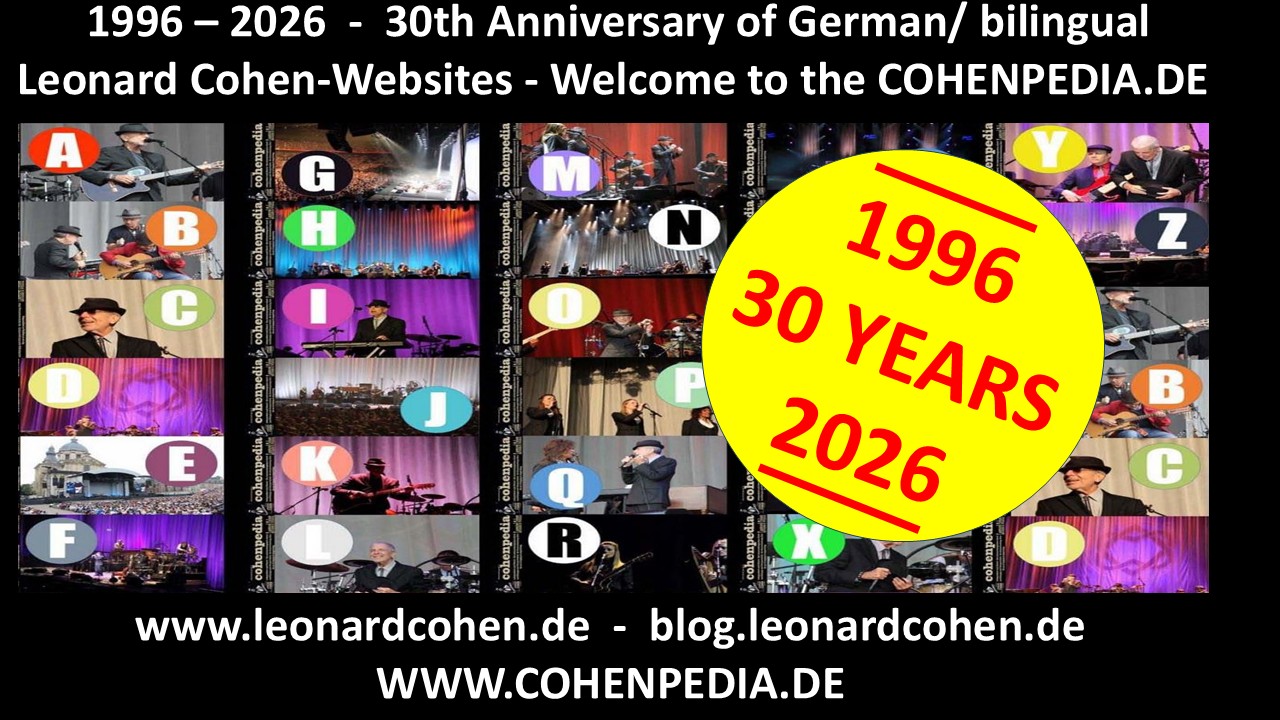
30 years ago, Christof Graf from Zweibrücken launched the first German-language website about Leonard Cohen. Today it is one of the most extensive in the world. Christof Graf revealed how this digital development of an analogue passion came about in an interview with DIE RHEINPFALZ editor Christian Hanelt on the occasion of the 25th anniversary of COHENPEDIA. Based on the article at the time, the conversation is now being updated in 2026…
In 2026, your German-language Leonard Cohen website will have been on the net for 30 years. How did that come about?
In terms of the Internet, the initial spark came from the Finnish webmaster Jarkko Arjatsalo, who put the first so-called leonardcohenfiles.com on the Internet in 1995. He asked me if I could provide him with texts and photos for what was then the world’s first Leonard Cohen website. When I saw that Cohen himself also published some material on this website, it made me a little proud. Over the years, I have repeatedly provided Jarkko with reports and photos, such as a visit to the Chelsea Hotel in New York, festival appearances or trips to Cohen’s hometown of Montreal – all in English. In 1996, my first Cohen biography „Partisan of Love“ was published, and I decided to put parts of it online. This was the birth of the first and still the most comprehensive German-language website about the Canadian rock poet.
From which your Cohenpedia was born?
Yes, since the mid-90s I was enthusiastic about the Internet. It is said that around 1996 the first million users were online in Germany. I was one of them and experimented with the AOL members pages of the time. Then I joined the worldwide Cohen web ring and registered the domain leonardcohen.de, which became cohenpedia.de. By attending many Cohen concerts and interviews with Cohen from the 80s onwards, I developed an archive from which I still draw today.
What is it about for you?
I have always been interested in documenting Leonard Cohen’s artistic life as a rock poet in a journalistic way. The website is still a „work in progress“. At the time, I liked the idea of turning it into something that would later be called content management. A kind of Wikipedia around the topic of „Leonard Cohen“. There are articles, interviews, photos in various digital formats, podcasts, links, a YOUTUBE channel, FACEBOOK and INSTAGRAM accounts and also a blog. The site now sees itself as a platform for everything Cohen-relevant.
This year, 2026, marks the tenth anniversary of Cohen’s death. Is there still something to report about him?
Yes, it is a pleasure to deal with old as well as new material again and again and to include it in the Cohenpedia. In the meantime, there are also numerous guest contributions by other authors who make their materials available to me. There are also reports about other singer/songwriters in the tradition of Cohen who are somehow connected to his work. It’s about artists who have worked with him or new, young artists who interpret his songs.
What makes your website different from others of this type?
It has existed for 30 years, which is not a matter of course in the fast-paced nature of the Internet. It is not commercial and tries to present things that cannot be found everywhere else. I still try to give the website an independence. In addition, blog.leonardcohen.de regularly and weekly reports on the singer/songwriter and music scene, which sometimes has nothing directly to do with Cohen, but with pop music philosophy in the tradition of the Leonard Cohens, Bob Dylans, Nick Caves & Co.
What are the benefits of working with Leonard Cohen?
For me, Cohen’s lyrics, songs and life are an enrichment for any kind of creativity. He always gave me room for reflection with his entire work.
Can other Cohen fans get involved on the site?
It is not a platform in the classic user-oriented social media sense, it has no comment function and no chat rooms, it is a space for research and reflection. It is about a documentary offer to immerse oneself in the complete work of a great contemporary philosopher of rock history. I pass on something that I was able to experience through the experience of art: inspiration and creativity. I try not to let a copy and paste culture arise on the website and only publish authorized content, which makes Cohenpedia a medium and press organ.
Does the site also have weaknesses?
Of course. It’s not a challenge for a web designer, I’m not a web designer. On the other hand, I am self-sufficient in terms of IT administration, and the website is easy to handle on the basis of the WordPress software and I create all the files myself. I’m not interested in technology, but in content. From the beginning, I wanted to create a kind of digital rock-poetic landscape that can be a place of inspiration just like Cohen’s work. Not for everyone, only for those who like to take a digital walk through Cohen’s garden of Zen and poetry.
How did today’s marketing professor Christof Graf come up with Leonard Cohen, of all people?
My first contact with rock and pop was through my sister, who was six years older, and through a school friend who was two years older than me and his older siblings, who took us to rock concerts in the mid-70s. So I am glad that I was able to experience Leonard Cohen’s only performance he ever had in Saarland on May 2, 1976 in the Saarlandhalle in Saarbrücken. But I’m also glad that I saw the Rolling Stones live in Stuttgart in 1976 or Bob Dylan live in Nuremberg in 1978. And the open airs in Ludwigspark in 1978 and 1979 were also to blame for the fact that I could no longer refrain from live concerts, and at some point during my studies I began to report on them for daily newspapers and radio stations. For me, Cohen is one of the more profound representatives of pop philosophers and managed to direct my gaze to so many other worlds, such as the beat generation. Without this gaze, I would never have read texts by Yates, William S. Burroughs‘ „Naked Lunch“ or Jack Kerouac’s „On The Road“.
What memories do you still have of your first Leonard Cohen concert?
It made a lasting impression on me, and the memory has accompanied me through my life as a soundtrack, just like Cohen’s songs. I still remember the beginning of the concert with „Bird on a Wire“, which he even played a second time solo on an acoustic guitar at the end of the concert. At that time, there were no hits like „First We Take Manhattan“ or „Hallelujah“. The concert, which lasted about two hours, lived from the songs of his first five albums, such as „Suzanne“, „So Long, Marianne“, „Sisters of Mercy“ or „Famous Blue Raincoat“. I was completely fascinated by how he managed to take several thousand visitors into his world of minimalism and turn a concert hall into a place of worship. After the concert, I waited backstage at the Saarlandhalle to get an autograph on a concert poster. After the concert, I knew that this was not my last concert. From tour to tour, I attended more and more Cohen concerts, similar to what I later did with Bob Dylan. For me, Cohen, Dylan or the Stones were the personification of rock’n’roll, an expression of freedom and spirit. Cohen knew how to project images in the minds of his listeners with word and sound, creating space for interpretation without sacrificing profundity. He is a wordsmith of the noblest kind, which hardly any other artist in popular music is able to do, except for Bob Dylan or Nick Cave. Cohen was the bohemian, the Lord Byron of popular music until his old age, who cultivated a lifestyle that I see as exemplary artistically.
Why are other artists now also represented on Cohenpedia?
First of all, it’s about what the title of the blog also says: It’s about „popular problems, different points of view and other old ideas“, in reference to some of his album titles such as „Various Positions“ (1985), „Old Ideas“ (2012) and „Popular Problems“ (2014). It’s about a lot that concerns the cohen-related art of songwriting and is therefore worth documenting. And that includes artists who inspired Cohen, or those who felt inspired by Cohen. By the way, Leonard Cohen was one of the first artists in the 90s, along with Bob Dylan, Peter Gabriel and David Bowie, whose web presence was based on fan-based websites. You wouldn’t believe who Cohen has had to do with. Since the end of the 80s until today, I have been conducting interviews with artists and always ask for their opinion of Leonard Cohen. Some didn’t know what to say about Cohen, and others immediately went into raptures?
Who raved?
Peter Gabriel told me how he visited a gallery in Montreal with Cohen in the old town there. The founder of the hard rock band Krokus told me about a taxi ride with Cohen through New York. The founder of Uriah Heep, Ken Hensley, who died in 2020, told me a five-minute story about how he met Cohen in Munich in 1972.
And what story did he tell?
This exact story can be heard in the original sound on the Cohenpedia site, as well as fragments of a last fireside chat with Cohen, about four weeks before his death, when I last met him in Los Angeles in October 2016.
Did Cohen know about your online activities?
Yes. In 2001 he made drawings available to me as mail for the first time or gave me a signed guitar or sent me an e-mail every now and then and thanked me for the German Internet presence. On his world tour from 2008 to 2013 I was invited back-stage several times. His own artist page (leonardcohen.com) links to my Cohenpedia, and his record company Sony also refers to the Cohenpedia.
You continued to deal with him even after Cohen’s death in 2016 …
Yes, from my point of view, the topic of „Leonard Cohen“, his life and work, gives so much more than what a daily newspaper, a magazine article or a book has given so far. In addition, creative friendships and cooperations arise on the Internet. In the spring of 2021, in the middle of the pandemic, a book with the Hamburg author Michael Brenner was published. He still lived to see Cohen’s beginnings in the late 60s, early 70s. We exchanged ideas virtually for two years, which eventually resulted in a book entitled „Views of Leonard Cohen“.
And even during and after the pandemic, Cohenpedia continued and continues to do so. Among other things, you wrote a book about Leonard Cohen’s hometown of Montreal ?
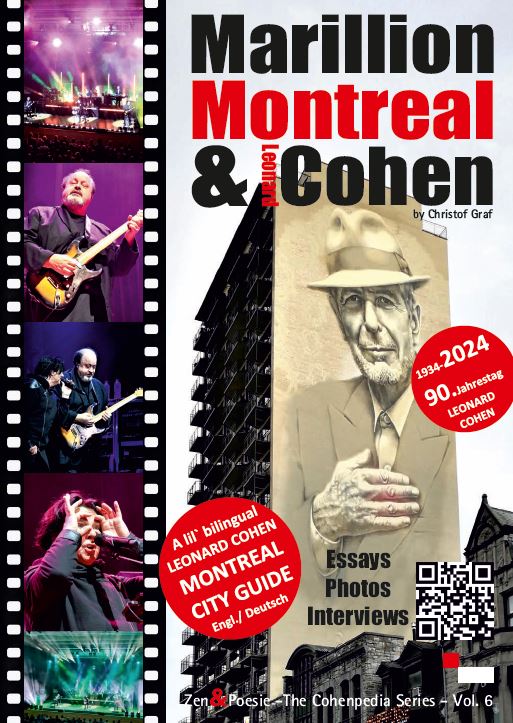
Yes, thanks to a good friend who lives in Montreal, who has been inviting me regularly since the year 2000, I went in search of the so-called „Cohen Places in Montreal“, i.e. places that had to do with Cohen’s life and work, such as Cohen’s childhood home, later home, schools, favorite pubs and restaurants or even the „Lady Of The Harbour“ sung about in „Suzanne“, etc. There are small stories about this in the book or notes, photos and route sketches. The book is called „Marillion, Montreal and Leonard Cohen“ and also addresses the affinity of the British prog rock band „Marillion“ to Montreal and Leonard Cohen. The one in 2023 was all about Montreal and Leonard Cohen, which was symbolized by the set design and their Cohen tribute song „The Crow and the Nightingale“ (from the „An Hour Before It’s Dark“ album from 2022). All of this is at the heart of the book „Marillion, Montreal and Leonard Cohen“, which contains hundreds of photos, biographies of the artists and three chapters entitled „Book Of Marillion“, „Book Of Montreal“ and „Book Of Leonard Cohen“.
On GOOGLE-MAP there is also a page with „Cohen Places“ to be found.
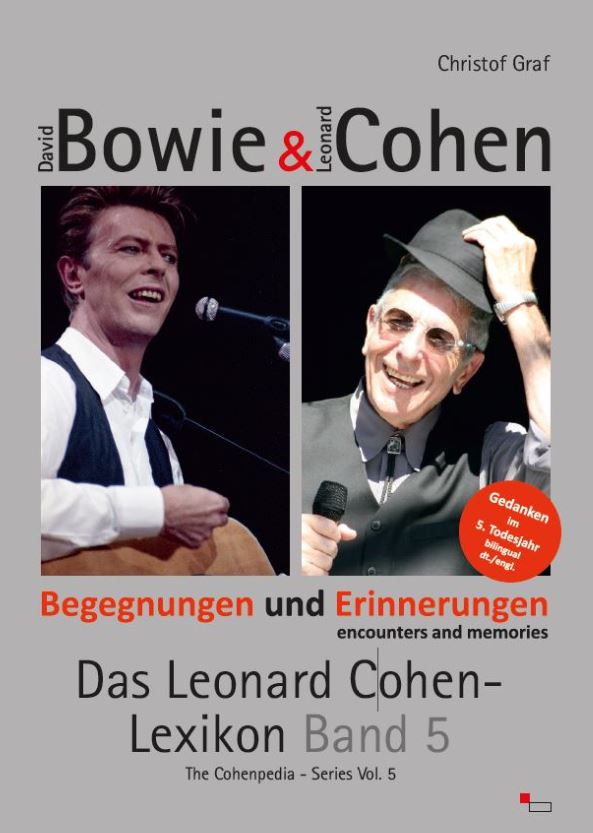
2016 marks not only the tenth anniversary of Leonard Cohen’s death, but also that of David Bowie. They have also written a book called „David BOWIE & Leonard COHEN – Encounters and Memories – Encounters & Memories“.
Yes, the book came out in 2021. 2016 was the year in which, surprisingly, a large number of popular music artists died. Two of these artists, David Bowie and Leonard Cohen, said goodbye shortly before their deaths with an album each that dealt with their own mortality. „Blackstar“ (01/2016) by David Bowie and „You Want It Darker“ (10/2016) by Leonard Cohen. In 2021, five years later and still today, the respective lives and works of these outstanding artists are still present and still resonate. Their music is unforgettable, reported on in the analogue media, and music, photos and stories of encounters with and memories of Bowie & Cohen continue to be posted and shared on social media. Her musical work cannot be erased from society’s long-term memory. Everyone who loves the music of „Bowie & Cohen“ and has encountered them in concerts, for example, has his own story of remembrance of it. And I summarized mine in this book „David BOWIE & Leonard COHEN“. More than 300 previously unpublished photos as well as a timeline of both artists complete the continuation of the book series „Zen & Poetry – The Cohenpedia Series“. An essay on the art of transforming mortality into music and the answer to the question of how David Bowie and Leonard Cohen met death musically complete the volume with „Number 5“.
In addition to your main job as a professor of economics and marketing at the Saarland Academy of Sciences (ASW) and at the University of Applied Sciences (htw saar), you are still working as a journalist and „rock photographer“, who also conducts interviews with rock and pop bands and also likes to talk about Leonard Cohen again and again. Who did you talk to recently and what did they say about Leonard Cohen?
Duff McKagan of Guns’n’Roses told me that his wife is a big Leonard Cohen fan. The front woman „Skin“ from the British band „Skunk Anansie“ or Michael Sadler from the Canadian band Saga raved about Cohen, as did the American blues singer „Beth Hart“.
What other book projects in the „Cohenpedia Series“ are planned?
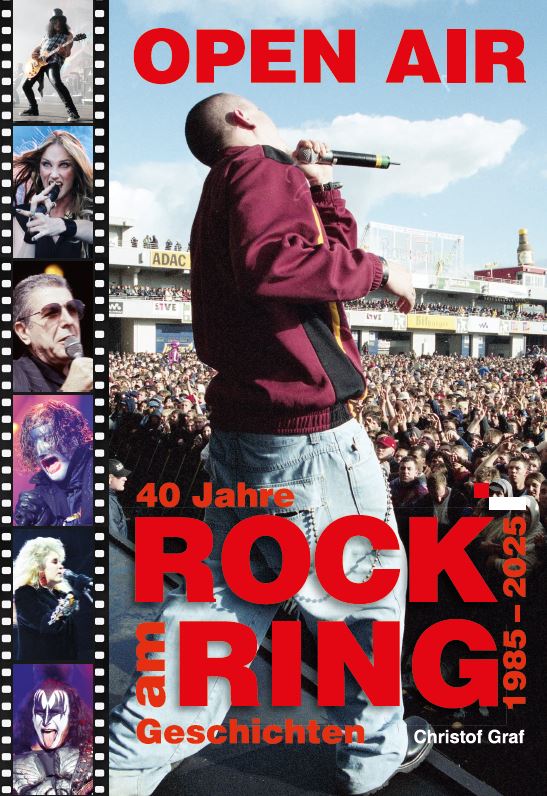
I am currently working on the book „Open Air – 40 Years of Rock am Ring History(s) 1985-2025“, which also deals with Leonard Cohen in one chapter. And my trip to Leonard Cohen’s former Zen monastery on Mount Baldy/ California and conversations with Zen monks will probably be processed into a book. And a book about Bob Dylan’s „Rough And Rowdy Ways“ world tour, which is also about the connection between Bob Dylan and Leonard Cohen, is also being considered.
Infos:
www.cohenpedia.de